|
|
~ New Western Glory ~the KRAM Components: DefinedThis article covers a brief background of the six KRAM components, their current use (with sample assessment values taken from an actual "in-training" assessment*), future applications in research and a description of each component as well as a basic description of how the values are derived. This article does not discuss the procdures for measuring and recording data. * Runner-pace should be taken into consideration when evaluating KRAM values. |
|||||||
The Kinematic Running Assessment Method uses Dartfish software;
"Dartfish has once again been chosen by NBC Olympics to provide technical and analytical enhancements at the 2008 Beijing Olympic Games" (Dartfish News, 2008). |
KRAM Components: Definedby Todd Nunan
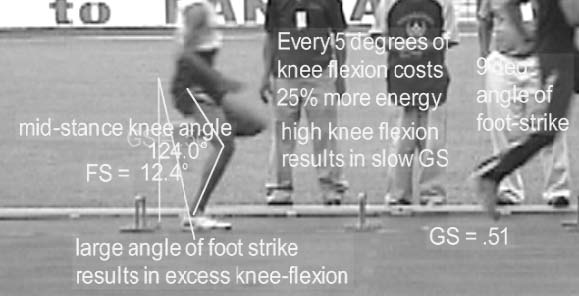
The Kinematic Running Assessment Method is a set of individual components that indicate specific biomechanical behaviors which have been shown to be associated with running efficiency. The system was generated from (a) common assessment practice (e.g. stride frequency), (b) various authorities in the track and field community including Olympic development programs individual distance running coaches, (c) personal revelation gleaned from competition experience, training experience and coaching experience, and (d) meta-analysis of current running science research. The construction of the six-component kinematic running assessment method (KRAM) was predicated on idea that a diagnostic kinematic efficiency assessment tool can also be used as a formative assessment tool to improve running mechanical efficiency in adults as well as children as young as nine (Snowman and Biehler, 2003, explain that at the fourth grade level, children show evidence of increased fine motor control). The components of this method are either measured by categorical qualification (e.g. foot above the knee vs. foot below the knee of recovery leg swing) or measured quantitatively in either degrees of freedom (e.g. degrees to the nearest tenth of a degree or decimal to nearest one-hundredth) or decimal fraction of a proportional value, as in GS. Current Application in TrainingThe KRAM system has been used as an analysis tool in various clinics held from June of 2007 until present in numerous locations including multiple clinics in Bacolod City/Cadiz City/Kabankalan on Negros Island, Philippines (see figure 1), The High Altitude Running Camp at Grouse Ridge in the Sierra Nevada Mountains, the Simplot Track and Field Clinic at Idaho State University in Pocatello, as well as numerous clinics held at public and private schools and universities in the western United States.
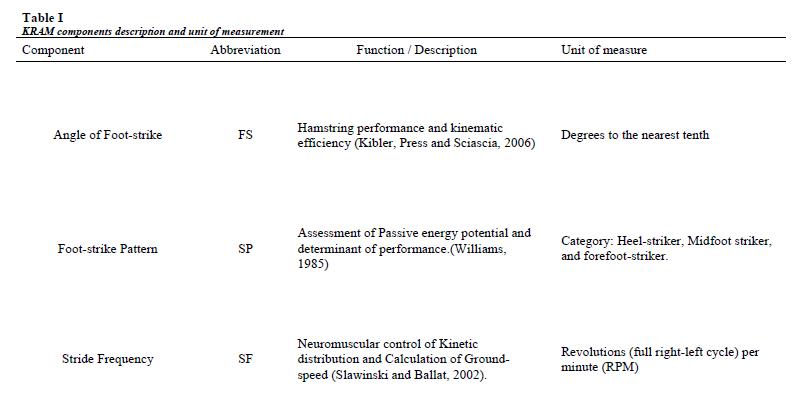
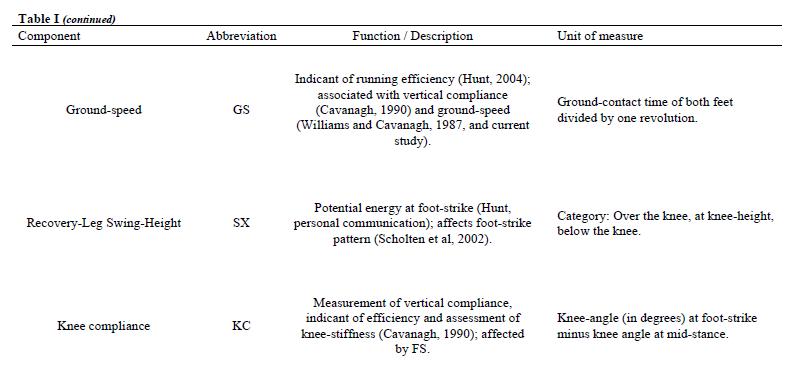
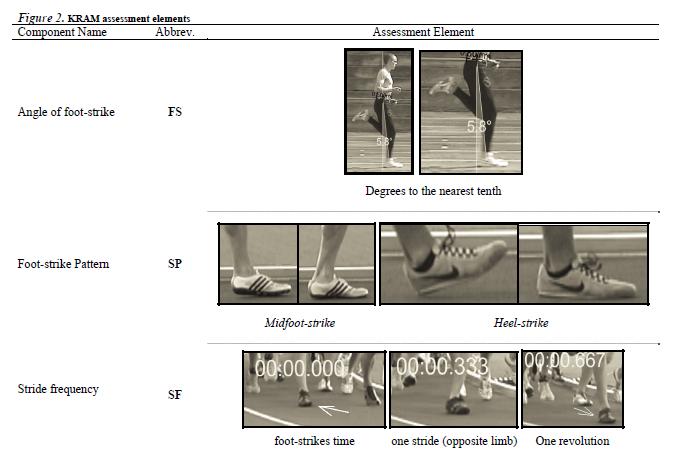
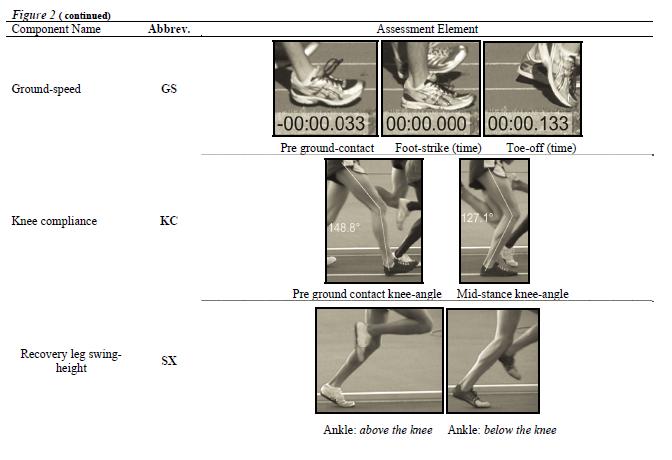
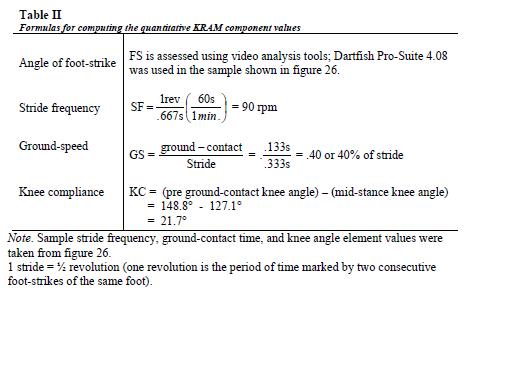
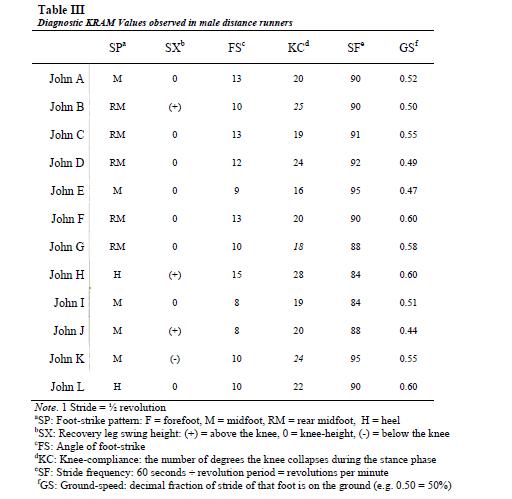
The measurement of these components in individual runners provides substantial information for assessing their competencies in relation to running efficiency. Table III shows the diagnostic assessment of male college cross country runners; these values were extracted from video analysis taken during a training run. This type of diagnostic analysis can be used for any age runner; formative, “in training” assessment would be recommended for ages eight years and older. (back to top) Future ApplicationThese components were also designed for use in research in athletics such as a longitudinal study proposed by the American Association of Health, Physical Education and Dance (AAHPERD); a call has been submitted to researchers who might provide empirical solutions to the dilemma facing our nation’s communities. An area of need is for evidence that shows “the relationship between physical competence (motor skills), learned in school physical education classes, and physical activity participation throughout the lifespan”. A longitudinal investigating of the association of physical skill acquisition and academic performance would also be a useful study in concert with the study conducted by the California Department of Education (2005) which showed a strong link between fitness and academic performance. The KRAM components are identified and functionally defined in table I. Figure 2 illustrates the categorical and quantitative measurement of the six KRAM components. Table II describes how quantitative data elements (taken from the examples in figure 2) are used to compute the non-categorical component assessment values. Table III shows a KRAM assessment score for 12 different male college aged cross country runners. (top) Component Description
Measurement of Component Values
Sample In-training Formative Assessment Values
Runner paces (approx. 5.7 ms) were not recorded but taken into consideration. |
|||||||